Models and Architecture
The following info is for reference about how CodeBot is built and what models it uses. It is not strictly pertinent to using CodeBot.
We use AI provers that allow us to provide services with guaranteed data privacy, per our data privacy statement. That link is the authoritative document on data including our provider(s) and should be used for all legal or approvals purposes.
Architecture
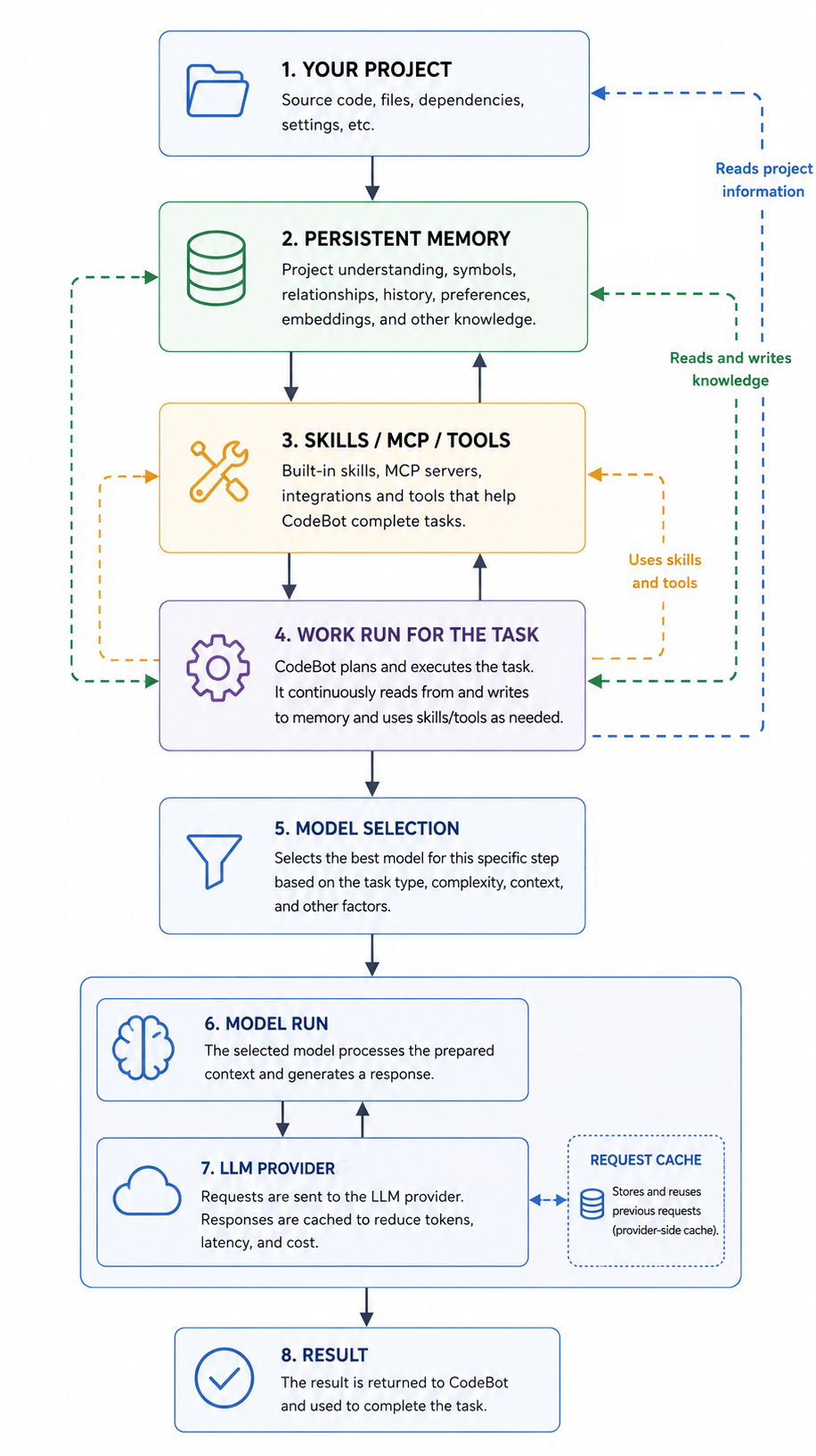
CodeBot is an agentic coding system built around a multi-agent orchestration architecture with shared memory and identity.
This means that unlike simple agents that wrap a single model and have a linear conversation history, CodeBot has multiple internal agents. Work or sub-items of work are delegated according to what each is; each kind of agent is specialised at specific kinds of work; agents can dispatch work to each other or to temporary subagents for subtasks; memory and identity is shared, with an internal memory architecture built around ensuring relevant information is kept present or made available as an agent needs.
The architecture is built to keep token usage small. We endeavour to avoid the need for memory compaction, though long runs can require a minor form of it. Instead our memory architecture makes the relevant information available at any time, allowing us to keep token usage down while the AI has the information it needs for its task as well as the entire session.
CodeBot is built using our AI Infrastructure library which also powers the version of CodeBot in Fire and Water, as well as AI in GitBrowser and Campfire. We plan to make this library available so that you too can create agentic AI systems as powerful as CodeBot. Contact us for more information.
Models
Different models are used for different purposes inside CodeBot, ranging from coding, planning, or subagents, right down to quick assessment of text, and many more internal features. The exact model used for any purpose is based on the intelligence level you've chosen, and the specific task. 'Task' here means an internal unit of work for CodeBot, not your task that you assign CodeBot.
The wide variety of internal tasks that work together to form CodeBot require models that demonstrate different capabilities; and can be done by more or less powerful models depending on the task. Choosing the right model lets us keep token costs down and provide more functionality per dollar than using a single expensive model for all tasks. For example, coding requires a strong model whereas a quick text summarisation might require a less powerful model.
Rather than specifying a specific model for the work (eg GPT 5.6) as a more simple agent might, we recommend choosing CodeBot's intelligence level. This selects the best model for each purpose. For example, we use a different model for planning work than for implementing that work. We have selected and tuned the behaviour for each intelligence tier.
RemObjects continuously evaluates and adopts the latest production-ready models from supported providers. As newer models become available, we update our infrastructure to take advantage of improvements in reasoning quality, coding performance, speed, and cost efficiency. Exact model versions may change over time without affecting the CodeBot experience.
Every AI model behaves differently. Because we build CodeBot to be non-generic, we tune CodeBot's behaviour for each model we support across providers in order to provide the highest capability possible.
Specialising in Delphi
We use a variety of techniques to ensure CodeBot is aware of modern Delphi, appropriate coding standards, libraries, and more. CodeBot is designed from the beginning to be more capable of good Delphi coding than a generic AI.
We do not train on or use any of your data. See Privacy and Data and our formal privacy / data notice which is intended for your legal or approvals purposes.